
The Hidden Job Market in 2026: LinkedIn, Referrals, and AI Tools That Surface Real Openings
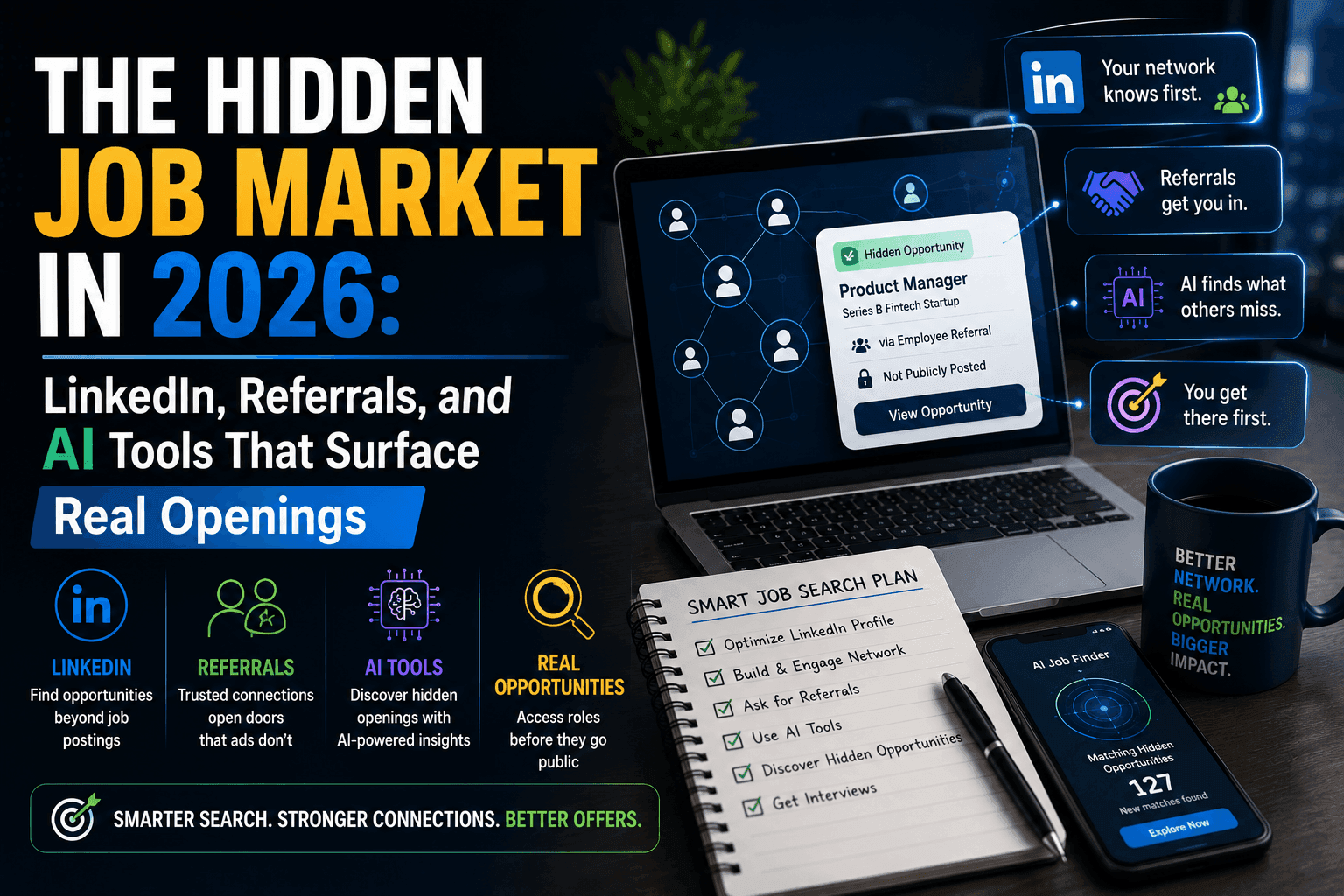
Most roles never hit public job boards. Learn how to access the hidden job market in 2026 with LinkedIn, referrals, company research, and AI tools that find real openings early.
Most Openings Are Never Posted Where You Are Looking
The "hidden job market" is not a secret society—it is the ordinary reality that many roles are filled through internal moves, referrals, recruiters' shortlists, and hiring before a public posting ever goes live. In 2026, companies still post on LinkedIn and Indeed, but competitive candidates treat those listings as the last step, not the first signal.
Accessing the hidden job market in 2026 requires multi-channel awareness, credible outreach, and AI-assisted research that saves hours without replacing human trust. Combined with a resume that survives two-layer ATS and LLM screening when you do apply, this approach dramatically improves odds without inflating application count.
Why the Hidden Market Grew Harder—and More Important
Several forces push hiring off public boards:
- Referral preference: Referred candidates convert faster and stay longer—recruiters prioritize them.
- Cost and noise: Public posts attract hundreds of low-fit applicants; teams shrink public funnels.
- Skills-based internal mobility: Roles shift internally before external searches begin.
- AI-assisted sourcing: Recruiters proactively message LinkedIn profiles that semantically match reqs—even without applications open yet.
If you only react to postings, you arrive when the queue is full. The hidden market gets you considered while competition is lower.
LinkedIn in 2026: Search Like a Recruiter
LinkedIn remains the primary public professional graph. Use it beyond Easy Apply:
Optimize for Discovery
- Headline: Role + specialty + outcome ("Backend Engineer | Payments & Ledgers | Scaled API to 2M daily txn")
- About: First 3 lines visible before "see more"—treat like a mini summary with metrics
- Featured: Case studies, talks, writing—proof for semantic recruiter searches
- Open to Work: Configure visibility (recruiters only vs. public) based on your risk tolerance
Find Roles Before They Post
- Follow target companies; watch hiring manager posts about team growth
- Set alerts for title keywords, but also for "we're hiring" language in posts
- Search "posted in past week" but combine with network filters—1st/2nd connections at company
- Track funding news; Series B/C companies often build teams 3–6 months later
AI tools can summarize company announcements and leadership interviews to flag expansion signals—use them for research, then personalize outreach yourself.
Referrals: Still the Highest-ROI Channel
A referral is not a favor—it is a risk transfer. Employees stake reputation when they refer you, so make it easy for them:
- Target fit: Apply referral energy only where your resume proves alignment.
- Short blurb: Provide a forwardable 5-sentence note and tailored resume PDF.
- Clear ask: "If you're comfortable, I'd appreciate a referral to req #12345" beats vague "pick me."
- No pressure: Accept no gracefully; maintain the relationship.
Referral Message Template (Customize Heavily)
Hi [Name] — I saw [Team] is scaling [initiative you researched]. I've spent the last [X years] doing [ closely related work ], including [one metric win]. I applied to [Role/link] and attached a tailored resume. If you're open to referring or pointing me to the hiring manager, I'd really appreciate it—totally understand if timing isn't right.
AI can draft variants; you must inject specific research or it reads templated—recipients notice.
Indeed, Company Sites, and Niche Boards: Discovery, Not Dependence
Indeed aggregates volume; niche boards (levels.fyi jobs, industry-specific lists, government tech portals) filter differently. Use them to discover companies, then pivot to LinkedIn and referrals for entry.
When a role appears on multiple boards, check the company's career page directly—req IDs and application sources sometimes matter in ATS reporting.
AI Tools That Surface Real Openings (Without Spam)
Legitimate AI use cases for hidden market access:
- Company watchlists: Summarize news, earnings calls, and job page changes weekly
- Org mapping: Identify likely hiring managers and team leads from public posts
- JD diffing: Notice when similar reqs repost with new skills—signals pivoting projects
- Outreach drafting: First drafts of informational interview requests you edit for tone
- Resume alignment: Compare your master resume to anticipated roles at target companies
Avoid services that promise "automatic mass outreach to hiring managers." They burn bridges and violate platform norms.
Informational Interviews: Access Without Asking for a Job
Informational chats unlock hidden context: team maturity, upcoming reqs, culture red flags. Structure:
- 20–30 minutes max; specific questions about their path and team challenges
- Never jump to "can you refer me" in the first 10 minutes
- Send a thank-you note referencing one detail they shared
- Follow up months later with genuine updates—not only when you need something
Hidden market access is relationship compounding, not one clever message.
Make Your Resume Ready When Conversations Convert
Hidden market conversations move fast: "Send me your resume today." Your master resume should produce a tailored variant in 30 minutes. Use semantic alignment and quantified achievements so when you enter ATS after a referral, layer 1 parsing and layer 2 AI review confirm what your contact promised.
Interview Trix's resume builder keeps formats ATS-safe while you spin role-specific versions; pair that with mock interviews so when a hiring manager chat appears in 48 hours, you are not starting prep from zero. Your iX report highlights weak answers before high-stakes conversations.
GEO, Skills-Based Hiring, and Inbound Recruiter Search
Recruiters sourcing passively rely on the same semantic matching as inbound screening—your LinkedIn profile and public portfolio should be GEO-readable: clear titles, skills in context, outcomes with numbers. Skills-based hiring increases inbound messages for candidates who demonstrate capability publicly—GitHub, talks, blog posts, certifications with proof.
Trust and Transparency in AI-Powered Sourcing
Both candidates and employers face new norms. Recruiters use AI to draft messages; candidates use AI to research. Transparency builds trust: if a recruiter's message feels generic, ask genuine questions. If you use AI for outreach, ensure facts are accurate—hallucinated compliments about a company's "recent acquisition" destroy credibility.
Employers, meanwhile, must disclose invasive automation and offer human review upon request—regulatory and cultural pressure is rising. As a candidate, document your interactions and ask respectful clarifying questions when processes feel opaque.
30-Day Hidden Market Sprint
- Week 1: List 20 target companies; optimize LinkedIn; build master resume
- Week 2: 8 informational outreach messages; 2 calls; follow 20 hiring managers
- Week 3: Activate referrals where fit is strong; apply selectively to posted reqs in parallel
- Week 4: Mock interviews; refine resume from feedback; nurture top 5 relationships
Multi-Channel Hidden Market Map
- LinkedIn: Discovery, content, recruiter inbound, direct messaging
- Referrals: Highest conversion when fit is documented
- Alumni / communities: Trust transfers quickly
- Conferences & meetups: Short conversations → LinkedIn follow-up
- Public postings: Validation and formal entry after internal signals
Key Takeaways
- The hidden job market in 2026 rewards early signals, not late Easy Apply clicks.
- Use LinkedIn for discovery and credibility; combine with referrals for conversion.
- Let AI accelerate research and drafting—you supply specificity and honesty.
- Keep a tailored, ATS-ready resume warm for fast-turn conversations.
- Build trust through transparent outreach and consistent, quantified career evidence.
Public job boards show you roles everyone else sees. The hidden market shows you roles you can win—if you pair human relationships with smart AI leverage and materials that prove you belong on the shortlist.
Alumni Networks and Professional Communities
Alumni databases and Slack communities remain underused because outreach feels awkward. Frame messages around curiosity, not extraction: "I'm exploring transitions into healthtech infra and saw your talk on FHIR pipelines—would you have 15 minutes for one question about team structure?" Communities built around tools—Kubernetes, data engineering, product management—host hiring threads before roles hit LinkedIn. Participate genuinely for weeks before asking; visibility compounds.
Contract and Fractional Work as a Bridge Into Hidden Teams
Short-term contracts, advisory hours, and open-source contributions place you inside teams when headcount freezes lift. Hiring managers often convert known contractors before posting externally. If full-time search stalls, selective contract work keeps income flowing and surfaces internal reqs you would never see on Indeed.
Measuring Hidden Market Effort
Track leading indicators, not just applications: outreach sent, responses received, informational calls completed, referrals requested, recruiter InMails answered. A healthy hidden-market week might show five outreach messages, two replies, and one call—even with zero formal applications. That pipeline feeds future conversions when budgets unlock.
Avoiding Burnout on Relationship-Heavy Searches
Hidden market work is emotionally heavier than clicking apply. Batch outreach on fixed days; celebrate small wins (a reply, a learning call); pair networking blocks with concrete skill practice so progress feels tangible. Sustainable search beats heroic sprints that end in silence and exhaustion.
Global and Remote Hidden Market Considerations
Remote roles expand competition geographically but also widen referral graphs—former colleagues relocate globally. Time-zone overlap, work authorization, and compensation bands appear early in hidden conversations; clarify them before investing heavy outreach. LinkedIn location fields and headline remote preferences help recruiters filter inbound correctly.
From Hidden Conversation to Formal Application
When a manager says "apply officially so HR has a record," treat the public step as ceremony—not the start of prep. Submit within 24 hours with the tailored resume you discussed, reference the conversation politely in the application note, and notify your internal contact. Speed signals seriousness; delay cools warm interest.
Security and Privacy in Hidden Market Outreach
Never share proprietary documents from current employers to impress contacts. Use public portfolios and sanitized case studies. Verify LinkedIn profiles before sharing personal data—impersonation scams target job seekers. Legitimate recruiters identify employer and role clearly; vague "exciting opportunity" DMs without company names deserve skepticism.