Aptitude Test Preparation for Placements 2026: A 4-Week Plan That Matches Real Test Patterns
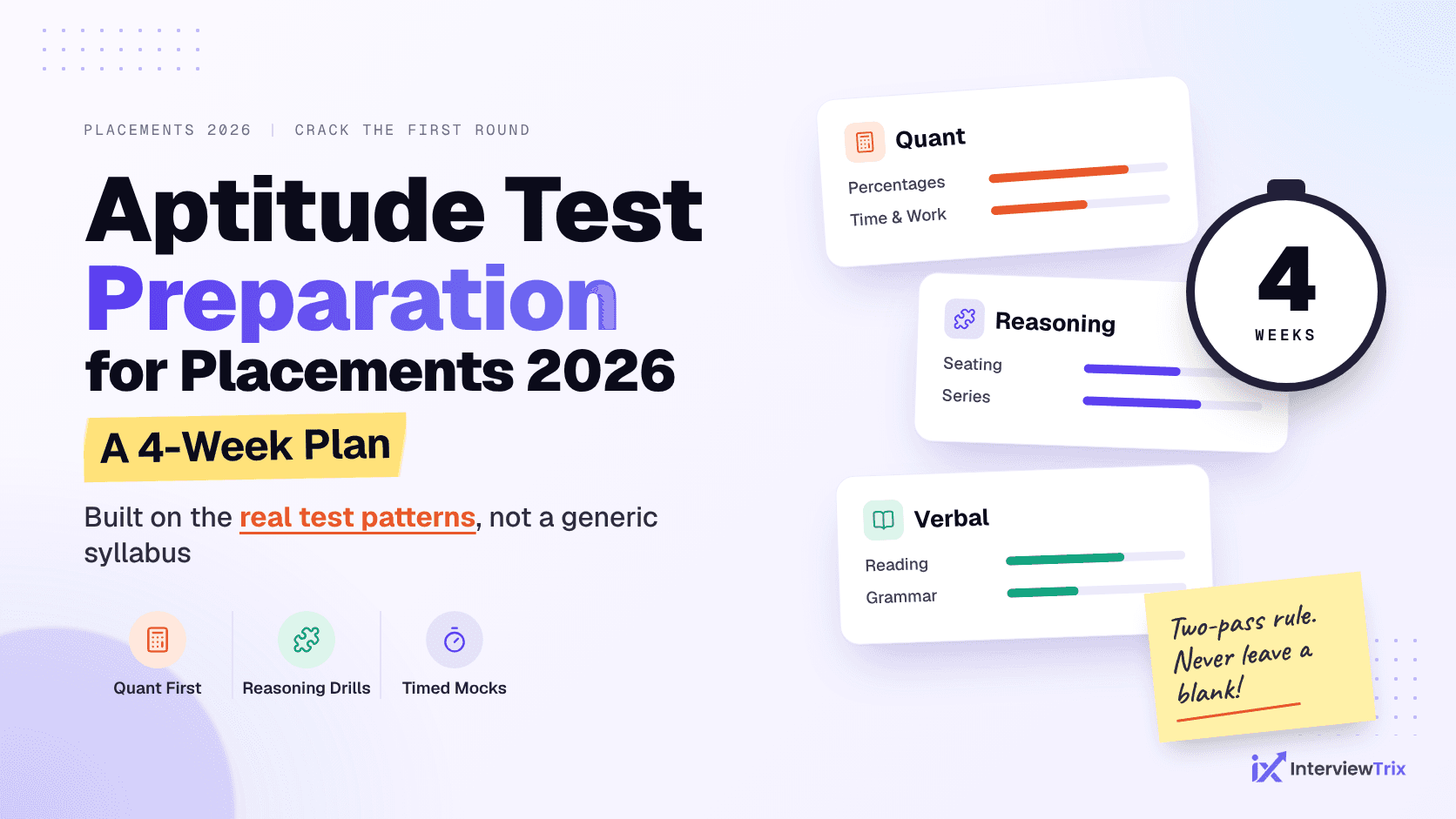
Aptitude test preparation for placements, made practical: how to prepare for the TCS, Infosys and Accenture tests in four focused weeks.
Why the aptitude test matters more in this hiring cycle
If you are sitting for campus or off-campus drives this season, aptitude test preparation for placements is the highest-return work you can do right now. The online test is the first cut. Fail it and your projects, CGPA and interview skills never get seen.
The good news: big IT services firms are hiring freshers again. The five largest Indian IT companies added 16,055 people between April and September 2026, and freshers made up roughly 60–65% of net new hiring, according to an Angel One report citing UnearthInsights. The same report says TCS expects to hire 25,000 freshers this year and Infosys expects 20,000.
The catch: this is not a broad recovery. Wipro told reporters in April it had no fresher hiring target for FY27, and only later signalled it would step up campus hiring in the second half. When seats are limited and applications are high, companies lean harder on the test to filter.
Your job is to clear it with margin, not scrape through.
What the 2026 tests actually look like
Stop preparing for a generic "aptitude test". Each company's format rewards different things. Here is how three of the biggest recruiters structure their online assessments, based on 2026 patterns published by placement-prep sites.
TCS NQT (pattern) — Aptitude sections: Foundation: Numerical (20 Qs), Verbal (25), Reasoning (20), each 25 min; Time pressure: ~75 sec per question, separate timers; Also tested: Advanced Quant + Reasoning (15 Qs, 25 min); 3 coding problems in 90 min; Negative marking: None reported
Infosys (pattern) — Aptitude sections: Logical Reasoning (15 Qs, 25 min), Mathematical Ability (10, 35 min), Verbal (20, 20 min), Numerical Puzzle (4, 10 min); Time pressure: Maths gets 3.5 min per question: expect harder problems; Also tested: Pseudocode (5, 10 min); 200–400 word essay (20 min); Negative marking: None reported
Accenture (pattern) — Aptitude sections: Cognitive: Verbal (17), Reasoning (18), Numerical (15); Time pressure: Shares a 90-min window with the technical section; Also tested: Pseudocode, MS Office, networking/cloud basics; 2 coding problems in 45 min; communication test; Negative marking: None reported
Three things jump out:
Verbal is not optional. TCS gives verbal the most questions in its Foundation section, and Infosys adds an essay. Many engineering students skip English prep and lose here.
Speed vs depth differs. TCS rewards fast, accurate basics. Infosys gives fewer maths questions with more time each, which usually means multi-step problems.
Your TCS Foundation score sets your track. FACE Prep reports that Ninja roles are decided on Foundation alone, while Digital and Prime also count the Advanced section. A strong aptitude score is literally worth a higher starting package.
With no negative marking reported in any of the three, never leave a question blank. A guess costs you nothing.
Aptitude test preparation for placements: the syllabus by priority
You cannot master everything in four weeks, so prioritise. These topics recur across almost every IT services test.
Quantitative aptitude (do these first)
Percentages, ratio and proportion, averages: the base layer for half of all quant questions
Profit and loss, simple and compound interest
Time and work, pipes and cisterns
Time, speed and distance (trains, boats and streams)
Number system, HCF and LCM, divisibility
Permutations, combinations and probability
Data interpretation: tables, bar and pie charts
Logical reasoning
Series (number and letter), coding-decoding
Seating arrangements and puzzles
Blood relations, direction sense
Syllogisms, statement and assumption
Data sufficiency
Verbal ability
Reading comprehension
Sentence correction and error spotting
Para-jumbles and sentence completion
Vocabulary in context (not memorised word lists)
If you are short on time, get topics 1–4 of quant, seating arrangements and reading comprehension to an "automatic" level. They carry the most marks for the least effort.
A 4-week plan for placement aptitude tests (about 2 hours a day)
This aptitude test preparation for placements plan assumes you are in final year with classes running. If you have more time, stretch each week to ten days rather than adding more topics.
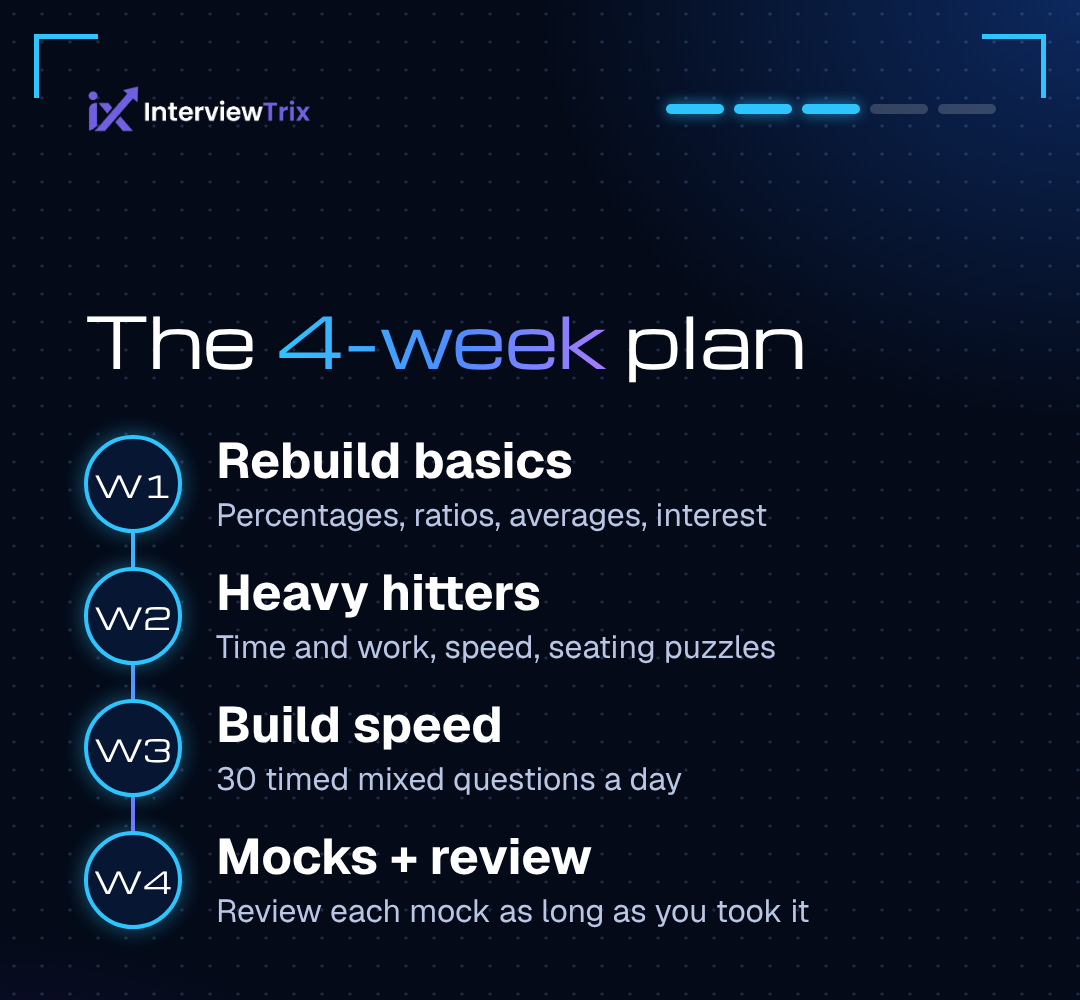
Week 1: Rebuild the basics
Quant: Percentages, ratios, averages, profit and loss, interest. Learn the concept, then solve 20 easy questions per topic.
Reasoning: Series and coding-decoding, 15 minutes daily.
Verbal: One reading comprehension passage a day. Note every word you had to guess.
Weekend: Write down your own formula sheet by hand. Making it is the revision.
Week 2: Add the heavy hitters
Quant: Time and work, speed and distance, number system.
Reasoning: Seating arrangements and puzzles. Draw every arrangement; never solve them in your head.
Verbal: Error spotting and sentence correction. Learn the 10 grammar rules you keep breaking (subject–verb agreement, tenses, prepositions, articles).
Weekend: First timed sectional test for each section. Do not worry about the score yet.
Week 3: Speed and mixed practice
Quant: Permutations, combinations, probability, data interpretation.
Daily drill: 30 mixed questions under a timer. Aim for under 60 seconds on easy questions.
Infosys-specific: Practise one 300-word essay and five pseudocode output questions.
Accenture-specific: Revise MS Office shortcuts and basic networking and cloud terms.
Weekend: One full-length mock in your target company's exact format.
Week 4: Mocks and error review
Two or three full mocks, spaced two days apart.
After each mock, spend as long reviewing as you spent testing. Sort every wrong answer into one of three buckets: didn't know, knew but too slow, careless.
Fix only your top two weak topics. This week is for sharpening, not for new chapters.
If your target test includes coding (TCS Advanced, Accenture), give it 30 minutes daily. Practising in the AI Coding Round gets you used to hidden test cases and explaining your complexity out loud.
Speed tactics that save 10+ minutes per test
Accuracy gets you to the cutoff. Speed gets you past it.
Two-pass rule. On the first pass, answer everything you can solve in under a minute. Mark the rest and come back.
Learn to drop questions. If a problem is not cracking after 90 seconds, guess and move on. With no negative marking, a guess is free.
Approximate before you calculate. In DI and percentages, options are often far apart. Rough maths picks the answer faster than exact maths.
Read the RC question first. Skim the questions, then read the passage looking for those answers.
Respect sectional timers. TCS runs separate timers per Foundation section. Time left in one section does not carry over, so pace each section on its own.
Practise on screen. Real tests are on a computer with on-screen calculators or none at all. Rough work on paper during practice should mirror what you are allowed on test day.
Common mistakes (and fixes)
Solving questions without a timer — Why it hurts: You learn methods but not speed; Fix: Time every set from Week 2 onwards
Skipping verbal because "English is fine" — Why it hurts: Verbal is a full scored section at TCS and Accenture; Fix: One RC and 10 grammar questions daily
Taking mocks but never reviewing them — Why it hurts: The same errors repeat in the real test; Fix: Review time = test time; log every mistake
Preparing for a generic pattern — Why it hurts: Infosys and TCS reward very different speeds; Fix: Practise in your target company's format
Ignoring what comes after the test — Why it hurts: Clearing aptitude only gets you to the interview; Fix: Book interview practice the week you apply
Applying with an unscreened resume — Why it hurts: Some off-campus portals screen resumes before sending the test link; Fix: Check your resume with the ATS Checker first
After you clear the test
The aptitude round usually leads straight into technical and HR interviews, sometimes within days. Do not stop at the test.
Prepare a 60-second "tell me about yourself" built around one project.
Revise the fundamentals of the language you chose for coding.
Practise speaking answers aloud. The AI Mock Interview runs company-specific rounds in English or Hindi and flags filler words and pacing, so your first real interview is not your first time answering out loud.
Key Takeaways
The online aptitude test is the first and biggest filter in IT services hiring, so start your aptitude test preparation for placements early and deliberately.
Check your target company's format: TCS rewards speed, Infosys rewards depth, Accenture mixes aptitude with technical basics.
Prioritise percentages, ratios, time and work, speed and distance, seating arrangements and reading comprehension.
Time every practice set from Week 2, and spend as long reviewing mocks as taking them.
No negative marking is reported for these tests, so never leave a question blank.
Plan for the interview round before you get the test result.
FAQs
How many days are enough for aptitude test preparation for placements?
Four weeks at about two hours a day is enough for most students who studied maths through Class 12. If your basics are weak, give Week 1 an extra week before moving on.
Is there negative marking in the TCS NQT aptitude section?
Prep sites covering the 2026 pattern report no negative marking, so attempt every question. Confirm in your official test instructions, as rules can change by drive.
Which aptitude topics are most important for campus placements?
Percentages, ratio and proportion, time and work, time speed and distance, number system, seating arrangements and reading comprehension appear in almost every IT services test.
Can I clear the aptitude test without coaching?
Yes. Free topic-wise practice plus timed mocks in your target company's format is enough for most students. What matters is consistent timed practice and mock review, not the course you buy.
Does the TCS NQT score affect my salary?
Indirectly, yes. FACE Prep reports that TCS maps candidates to Ninja, Digital or Prime tracks based on test performance, and those tracks have different starting packages.
Is verbal ability really tested in IT company aptitude tests?
Yes. TCS NQT has a 25-question verbal section, Accenture's cognitive test includes 17 verbal questions, and Infosys adds a verbal section plus a short essay.
Start practising today
The best aptitude test preparation for placements starts with one honest baseline. Pick your target company, take one timed sectional test tonight, and let the score decide where your Week 1 starts. When you are ready for the rounds after the test, practise them in the AI Mock Interview.