AI Interviewer Tips for 2026: What the Bot Scores and How to Prepare
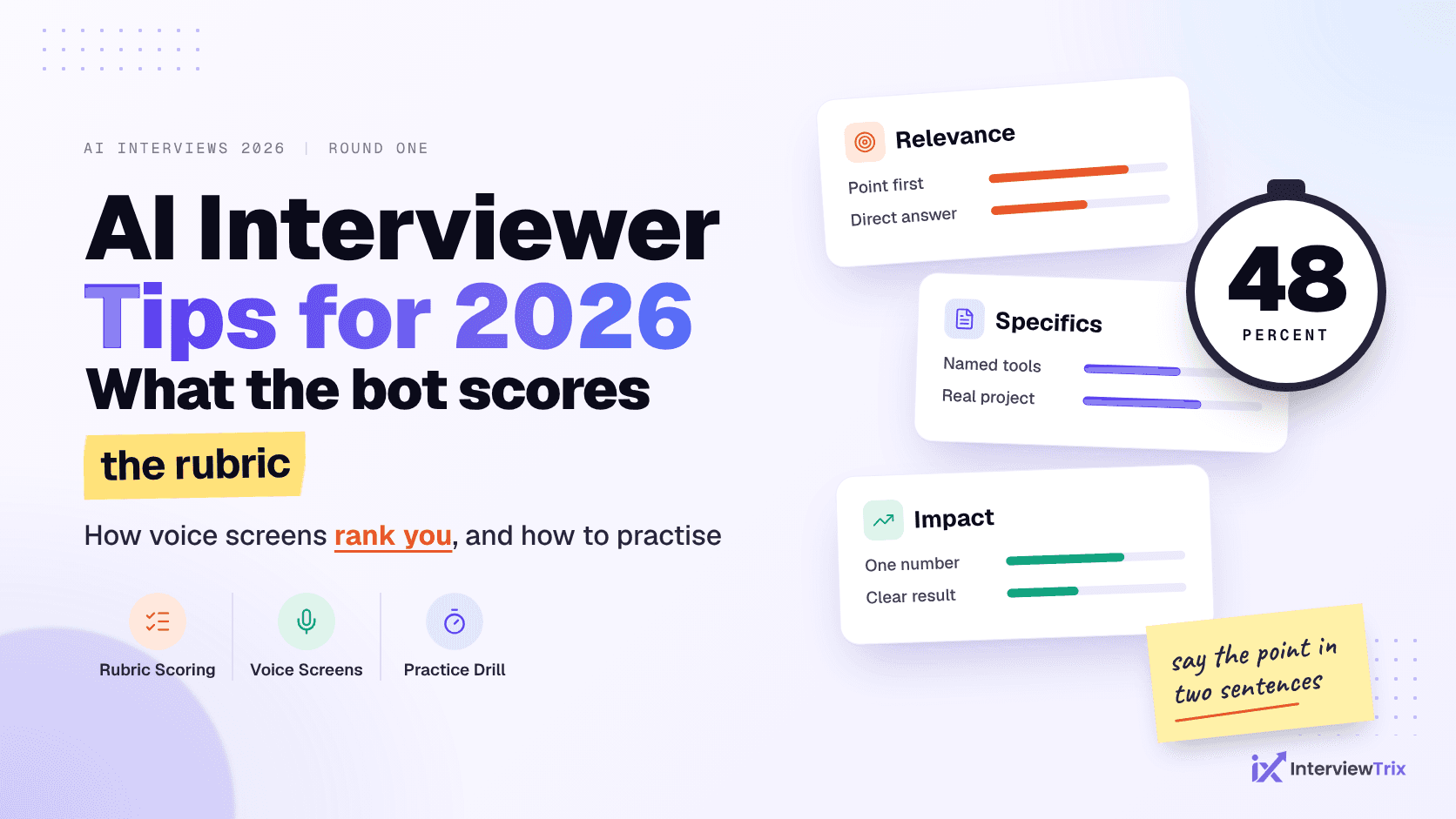
Voice AI screens now transcribe your answers, score them against a rubric and rank you before a human call. Here is what they score and a 25-minute drill to practise.
What changed this year
A year ago, an "AI interview" usually meant a one-way video where you talked to your webcam and a recruiter watched later. In 2026 the first round is often a live voice conversation with software that asks the questions, listens to your answers and scores them before any human looks at your file. These AI interviewer tips are written for that round.
Three things moved in the last twelve months:
- Exposure jumped. Greenhouse's 2026 Future of Hiring Candidate Report (October 2026) found that 48% of US job seekers took an AI interview in the past year. The survey covered 2,800+ candidates across five countries; the 48% figure is from the 1,200 US respondents.
- The bot now ranks you. In June 2026 HireVue launched a voice AI Interviewer that scores answers against IO-validated rubrics and produces a ranked shortlist before any human screening call.
- India is wiring AI into campus hiring. Deloitte India's Campus Workforce Trends 2026 reports that 72% of organisations use AI for resume screening and 48% use AI-based assessments, with AI-led video interviewing named as an emerging screening tool.
The data on AI interviews is mostly American so far. But the vendors sell globally, GCCs in Bengaluru and Hyderabad often run the same hiring stack as their US parent, and high-volume campus drives are exactly where automated first rounds make sense to employers. Assume you will meet one.
How an AI interviewer actually works
Strip away the branding and most voice screens follow the same loop:
- Fixed question set. The employer picks questions tied to the role: "Tell me about a time you handled an angry customer", "Walk me through a project where you used SQL".
- Speech to text. Your answer is transcribed. From here on, the system is mostly working with words on a page.
- Rubric scoring. Each answer is scored against a rubric written for that question. HireVue says its rubrics are IO-validated and derived from thousands of outcome studies, and it turns answers into quantitative scores.
- Ranking. Scores roll up into a ranked shortlist. A recruiter usually starts at the top.
- Human decision. In most setups a person still makes the call. In the Chicago Booth field study discussed below, humans made every hiring decision; the AI ran the interview and produced the transcript.
The practical point: you are being read more than watched. A Mint explainer from May 2026 on platforms like HireVue and TestGorilla describes these bots as analysing verbal content, scoring answers on relevance, specificity and measurable impact.
What the bot scores (and what it mostly ignores)
Rubrics differ by employer, but they tend to reward the same handful of things. Here is a working model you can prepare against.
- Relevance: You answer the question asked, in the first two sentences. Loses points: a long warm-up before the point.
- Specificity: Named tools, a real project, a real constraint. Loses points: "I am a team player and a quick learner".
- Evidence of impact: A number, a before/after, a result someone noticed. Loses points: "It went well".
- Structure: Situation, task, action, result in that order. Loses points: jumping between timelines.
- Role fit: Skills from the JD show up naturally in your stories. Loses points: keywords listed without a story behind them.
Mint's May 2026 explainer says these bots mostly judge what you say: the verbal content of your answers. A transcript does not show which college you went to, though your resume still might. The flip side is that charm does not transfer. The small talk that warms up a human panel does nothing for a transcript.
Your answer, before and after
Same question, two answers. Question: "Tell me about a time you solved a problem under a deadline."
Before (scores low):
"So, basically, in my final year I was part of a project and there were a lot of issues, and we had a deadline, so we all worked really hard as a team and finally we were able to finish it on time, and I learned a lot about teamwork."
No named problem, no action that belongs to you, no result beyond "finished".
After (scores well):
"In my final-year project, a Flask app for our college library, the search page took around 8 seconds to load two days before the demo. I profiled it, found we were running one query per book, and replaced it with a single joined query plus an index on the title column. Load time dropped to under a second and the demo went through without a hitch. Since then I check query counts before I check anything else."
Situation in one line. A problem with a number. Actions that are clearly yours. A result. A takeaway. That is what a rubric is built to find.
Seven AI interviewer tips that hold up
- Lead with the answer. Put the point in your first two sentences, then support it. Rubrics reward relevance early.
- Bring one number per story. Time saved, rows processed, marks improved, tickets closed. Small, honest numbers beat vague big claims.
- Use STAR, but keep it tight. Aim for 60 to 90 seconds per answer. Long answers bury the result.
- Mirror the JD in your stories, not in a list. If the role asks for Excel and stakeholder communication, tell a story where you did both. Listing skills you cannot back up is easy to catch in a follow-up round.
- Cut the filler. "Basically", "like", "you know" and long pauses make the transcript messy. In the Booth study, candidates interviewed by AI spoke more clearly and used fewer fillers. A clean transcript is easier for any rubric to score.
- Ask if a human reviews it. Greenhouse found 49% of candidates want to know a person will review their answers and 40% want to know how they will be evaluated. It is a fair question to ask the recruiter beforehand.
- Answer in your own words. Do not read AI-generated answers off a second screen. Mint notes this can lead to disqualification, and many employers state it in their rules. Practise with AI; perform without it.
Will the bot treat you fairly?
There is honest evidence on both sides.
The most cited field study comes from economists Brian Jabarian and Luca Henkel, summarised by Chicago Booth Review in March 2026. About 70,000 applicants for customer-service roles were randomly assigned a human recruiter, a voice AI interviewer, or their choice. Those interviewed by the AI were 12% more likely to get an offer and 17% more likely to still be in the job after 30 days. About 80% chose the AI when given the option, and reported gender discrimination was half as common in AI interviews.
Two limits matter. These were high-volume, structured roles, and the researchers themselves suggest that is where voice AI fits best today. And humans still made the final decisions.
The other side: an earlier Greenhouse survey reported by Fast Company in April 2026 found 70% of respondents said they were not told AI would evaluate them, and 20% were unsure whether they were talking to a person or a machine. The article does not state the sample size, but the signal is clear: disclosure is patchy. So prepare as if every first round could be automated, and ask when you are not sure.
How to tell if you are facing a bot
You may not be told. Look for these signs:
- The invite is a link, not a calendar slot. "Complete your interview within 72 hours" usually means an automated screen.
- Questions arrive with fixed timers. A countdown for thinking and answering time is a structured, scored format.
- No small talk and no follow-up on your jokes. The pacing feels even and the next question starts on cue.
- The platform name in the URL. If you recognise an assessment vendor, you are likely in a scored screen.
If you are unsure, ask the recruiter: "Is the first round AI-led, and will a person review my responses?" Recruiters hear this often, and it is a fair thing to ask.
Common mistakes (and fixes)
- Mistake: Treating it like a casual chat. Fix: Treat each question like a mini essay with a clear point.
- Mistake: Memorising scripts word for word. Fix: Memorise three to five stories and the numbers in them, then adapt the opening line to each question.
- Mistake: Practising silently in your head. Fix: Practise out loud and record yourself. The bot only hears what you say.
- Mistake: A resume that does not match your answers. Fix: Before the screen, check your resume against the JD in the ATS Checker so the skills you claim on paper are the ones you can talk about.
Try it on Interview Trix
Here is a 25-minute drill you can run tonight with the AI Mock Interview. It is voice-first, works in English or Hindi, and its report shows the same things a rubric looks for.
- Pick one real job description. Copy it from Naukri, LinkedIn or the company careers page.
- Start a General Screening round (10 minutes). Add the target company and role, upload your resume and paste the JD so the questions match the job.
- Answer as if it counts. No notes on screen, no pausing the session. Use your STAR stories.
- Read the report, in this order: fillers per minute and pauses first, then STAR detection, then the per-question view comparing your answer with a suggested stronger one.
- Fix two things only. For example: "drop 'basically'" and "add one number to the project story". Write them on a sticky note.
- Run a Technical Screening round (10 minutes) the next day with the same JD and check whether those two numbers moved.
Two short rounds a week for three weeks is more useful than one long session the night before.
Key Takeaways
- Nearly half of US job seekers met an AI interviewer in the past year (Greenhouse, October 2026), and 72% of Indian campus recruiters already use AI to screen resumes (Deloitte, 2026).
- Voice AI screens transcribe your answers and score them against a rubric, then rank candidates before a human call.
- Rubrics reward relevance, specificity, measurable impact and clear structure. Charm and small talk do not show up in a transcript.
- Evidence on fairness is mixed but not grim: in one 70,000-applicant study, AI-interviewed candidates were more likely to get offers.
- Practise out loud, with a timer, on real JDs, and answer in your own words.
FAQs
What do AI interviewers look for in answers?
Most score relevance to the question, specific examples, measurable results and clear structure such as STAR. The exact rubric is set by the employer for each question.
Can an AI interviewer reject me without a human seeing my answers?
It depends on the employer. Tools like HireVue's AI Interviewer rank candidates before a human screening call, so a low score can push you down the list. Ask the recruiter whether a person reviews responses.
How should freshers prepare for an AI interview?
Build three to five STAR stories from projects, internships and college work, each with one honest number. Then practise them out loud against a real job description with a timed mock interview.
Is it okay to use ChatGPT during an AI interview?
No, unless the employer explicitly allows it. Reading AI-generated answers can get you disqualified. Use AI to practise and get feedback before the interview, not during it.
Do AI interviews check body language or accent?
Many current voice screens mainly work from the transcript of what you say. Some tools may analyse more, so speak clearly and steadily, and check the employer's disclosure if one is shared.
Before your next application
Run one 10-minute General Screening round on the AI Mock Interview before your next application, and fix the two things the report flags. Build. Practice. Get Hired.